
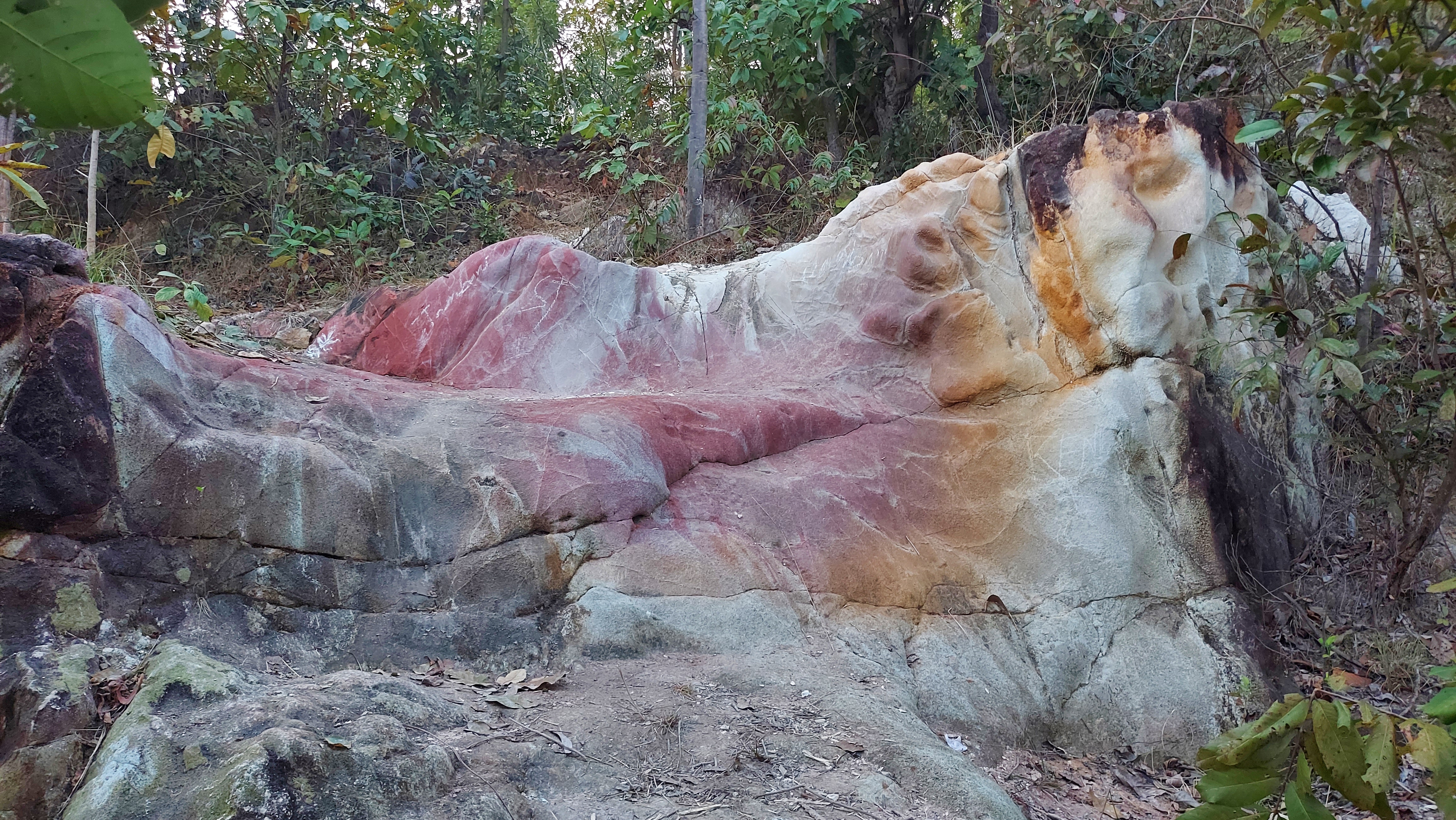
Tucked away in the dense, whispering forests of the Jangalmahal circuit, an incredible natural wonder is quietly capturing the hearts of offbeat travelers. Known locally as Khadan Dungri (Quarry Hill), Rangin Pahar is West Bengal’s very own "Rainbow Mountain."What makes this hillock mesmerizing is its raw, exposed rock faces that naturally display vibrant ribbons of brick red, golden ochre, and stark white. Far from being artificially painted, these colors are a geological masterpiece millions of years in the making.🔬 The Geology: Why is the Mountain Colorful?The secret behind Rangin Pahar lies right beneath its surface: it is an incredibly rich deposit of China clay (kaolin).
- The White Base (Pure Kaolin): The chalky, white layers at the base are high-grade kaolin—the highly refractory mineral used globally to manufacture fine porcelain and ceramics.
- The Crimson & Ochre Waves: Over millennia, groundwater rich in metallic minerals seeped through these clay beds. Iron oxide (hematite) stained the layers into deep pinks and brick reds, while hydrated iron oxides (limonite) created the golden yellow crests.
- The "Uluru" Effect: When the sun hits these mineral-rich rocks at different angles, they dynamically change hue. During sunrise and sunset (the golden hour), the colors intensify dramatically, drawing comparisons to Australia's famous monolithic rock, Uluru.
- Manganese Ore: Found nearby as heavy, metallic dark gray veins (pyrolusite), hosting West Bengal’s primary manganese deposits used for steel production.
- Quartz & Silica: Hard, crystalline deposits that form the rugged hillocks (known locally as Dungris) defining the landscape.
- Laterite Crusts: The iconic deep-red soil (morang) of Jangalmahal, packed with iron and traditionally used by locals to cut durable building blocks.
- By Personal Vehicle: Start from Jhargram town and head north toward Dahijuri via the Jhargram-Belpahari Road (SH 9). Follow the straight, smooth tarmac for about 45 minutes until you reach the bustling Belpahari More (crossing).
- By Public Transport: Regular state buses and shared jeeps track daily between the Jhargram Bus Stand and Belpahari.
- From the main Belpahari crossing, turn onto the road heading toward the Odolchua sector (moving northwest towards Kankrajhore).
- Drive through the winding forest corridors for 10 kilometers until you spot the prominent Khattadhara CRPF Camp.
- Right by the CRPF camp, take the sharp turn onto the narrower pitched village road.
- Follow this for about 1 kilometer until the tarmac transitions into a rustic, red-soil forest track (morang path).
- Park your vehicle here. A short, breezy walk of a few hundred meters through the wild shrubs will lead you straight to the multicolored China clay formations.
- Best Timing: Plan your visit for 3:30 PM onwards. The afternoon sun strikes the iron-rich stone at the perfect angle, causing the reds and yellows to vividly "pop" for photography.
- Combine Your Trip: Spend a full day in the area by pairing Rangin Pahar with nearby attractions like Khandarani Lake (perfect for birdwatching) and the rocky cascades of Ghagra Waterfalls.
- Leave No Trace: The site is heavily pristine and an active pride of the Odolchua villagers. Do not chip at the fragile clay rocks, and carry all your plastic trash back to the town.
No approved comments yet. Start the conversation.