
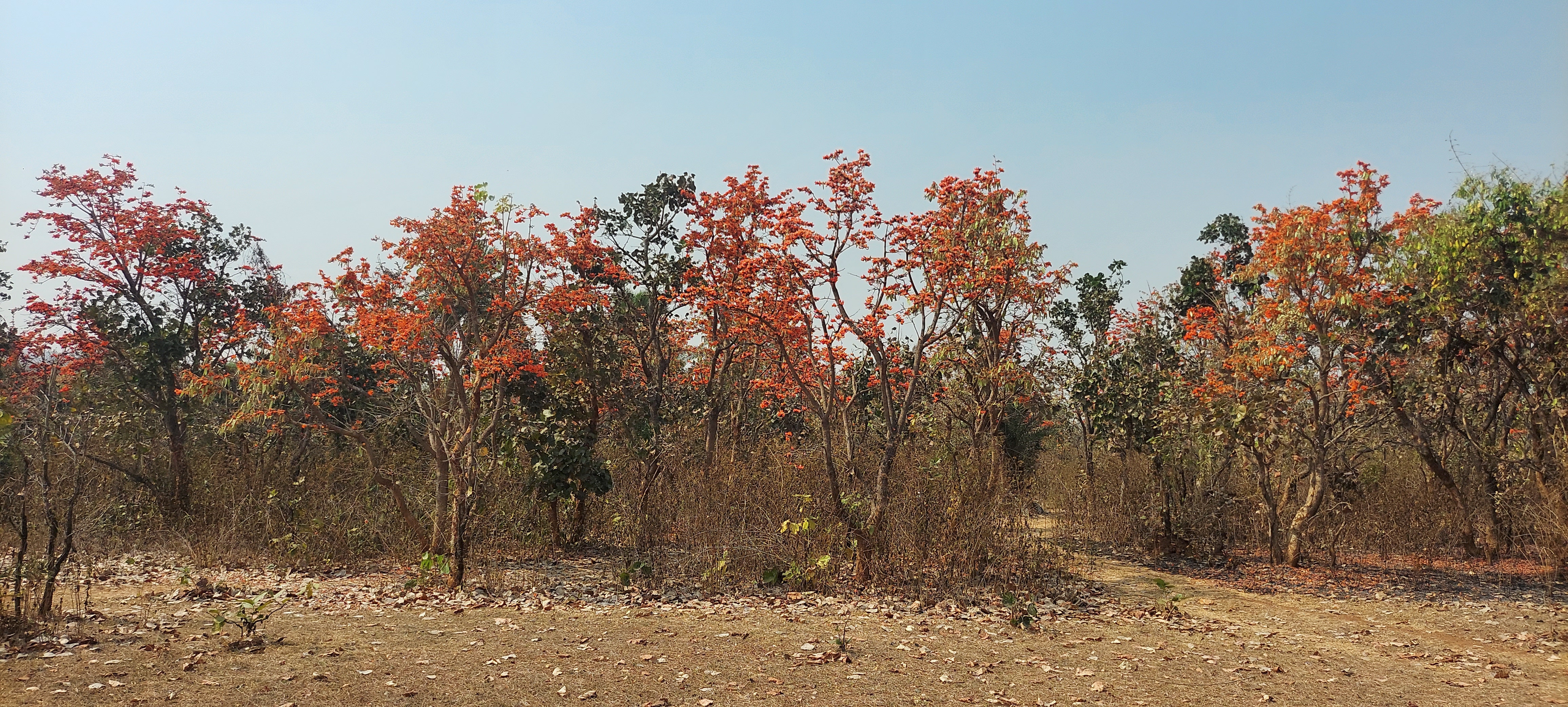
As winter retreats from the rugged terrains of West Bengal, a dramatic transformation sweeps across the district of Jhargram. The dry, sprawling forests of Sal and Mahua shed their muted tones, giving way to an explosion of fiery orange and brilliant red. This is the magic of the Palash flower, often called the "Flame of the Forest." For nature lovers, photographers, and weekend travellers, spring in Jhargram offers a visual spectacle unlike any other.
Here is your comprehensive guide to the Palash tree, its mesmerizing flowers, and how to experience this crimson wonderland in Jhargram.The Tree: Butea monosperma (The Flame of the Forest)The Palash tree is a sturdy, medium-sized deciduous tree native to the Indian subcontinent. Well-adapted to the arid climates and laterite (red) soil of the Rarh region, it thrives effortlessly across Jhargram’s rugged topography.- The Trunk and Bark: The tree features a crooked, twisted trunk with irregular branches. Its bark is rough, fibrous, and ash-coloured, giving it an ancient, weathered appearance.
- The Foliage: Palash leaves are distinctive—they grow in triplets (trifoliate). Before the flowers arrive, the tree sheds almost all its leaves. This unique trait ensures that when the blossoms appear, they sit upon naked, dark grey branches, creating a striking contrast that makes the canopy look like it is engulfed in wild flames.
- Shape and Color: The flowers are shaped like a parrot’s beak or a curved crescent. They exhibit a radiant palette ranging from bright orange to deep, velvety crimson.
- Texture: The petals have a soft, velvety texture, covered in fine silken hairs that catch the spring sunlight beautifully.
- Ecological Role: While virtually scentless, the cup-shaped flowers are rich in nectar. They act as vital lifelines in the dry season, attracting a bustling ecosystem of sunbirds, bees, and squirrels.
- The Color of Holi: Traditionally, Santhali and other local communities harvest the fallen petals to create a completely natural, non-toxic saffron dye used during Dol Jatra (Holi).
- The Call of the Wild: The blooming of the Palash signals the arrival of the spring festival, Saharai, and inspires local Santhali songs and dance forms that celebrate rebirth and nature's abundance.
- Chilkigarh Sacred Grove: Located near the Dulung River, the forest patches surrounding the historic Kanak Durga Temple offer a stunning backdrop where fiery orange petals blanket the sacred red earth.
- The Khatashol Rural Belts: Driving along the village roads of Khatashol reveals massive, isolated Palash trees standing proudly against open fields—perfect for landscape photography.
- The Lodhasuli and Jhilimili Borders: Taking the highway winding towards the Purulia border reveals dense pockets of dry deciduous forests where the trees bunch together, creating the illusion of a forest fire under the clear blue sky.
- Mid to Late February (The Awakening): As the winter chill fades, the Palash trees completely shed their green leaves. Tiny, dark grey buds start to appear on bare branches. A few early blossoms can be seen by the third week of February.
- Early to Mid-March (The Peak / Full Bloom): This is the absolute best time to visit. Coinciding with the Basanta Utsav (Holi) festival, the forests reach a peak full bloom. The canopy turns into a sea of blazing orange and crimson, creating the famous "wildfire" illusion across the red soil.
- Late March to April (The Crimson Carpet): The flowers begin to wilt from the intense spring heat. They detach and drop, covering the forest floor and dirt tracks in a beautiful orange carpet. By mid-April, new green leaves sprout, and the blooming cycle ends.
Travel Tips for the Palash Trail
- Best Time to Visit: Plan your trip between late February and mid-March. By late March, the flowers begin to carpet the ground, which is equally beautiful but marks the end of the bloom.
- How to Get There: Jhargram is easily accessible via a 3-hour train ride from Howrah, or a smooth drive via the NH16 highway.
- Respect the Environment: Avoid breaking branches to take photos. Enjoy the flowers on the trees or admire the fallen orange carpet on the forest floor.
No approved comments yet. Start the conversation.